
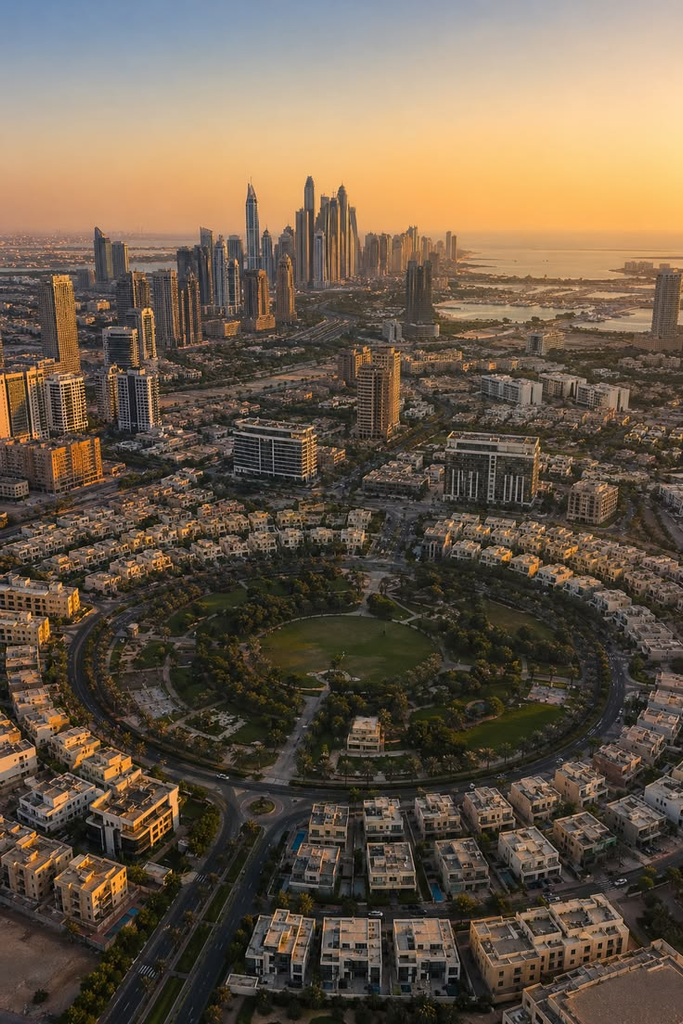
Dubai’s secondary residential market is showing early signs of renewed activity, with transactions rising 24.6% during July and August 2026 compared with May and June.
After a noticeable slowdown earlier this year, the latest numbers suggest that activity in Dubai’s ready-property market may be beginning to turn a corner.
The change is particularly interesting because summer is usually a quieter period for Dubai’s property market. In 2025, secondary transactions actually declined during the same period. This year, however, the market moved in the opposite direction.
A Different Summer for Dubai’s Property Market
According to analysis by Espace Real Estate, secondary residential transactions across Dubai increased 24.6% between May–June and July–August 2026.
That compares with a 14.2% decline during the equivalent period in 2025.
However, it is important to look at the numbers in context.
July and August 2026 transactions were still 44% below the same period in 2025. Earlier in the year, May and June activity had been 61.5% lower than the previous year.
So, while the latest figures point towards improving momentum, the market has not returned to the unusually high transaction levels seen in 2025.
What has changed is the direction of activity.
Instead of continuing to slow through the summer, Dubai’s secondary market recorded stronger transaction activity.
Established Communities Are Showing Stronger Momentum
The improvement becomes even more visible when looking at established residential communities.
Espace Real Estate examined five well-known Dubai communities:
- Arabian Ranches
- The Springs
- The Meadows
- Jumeirah Park
- The Lakes
Across these communities, transactions increased 24.3% from May–June to July–August 2026.
A year earlier, transactions across the same communities had declined by 6.7% during the comparable summer period.
There is also a notable difference in the year-on-year numbers.
While Dubai’s wider secondary market was down 44% year-on-year in July and August, transaction activity across these five established communities was down 26.3%.
This suggests that established, end-user-focused communities may be seeing a relatively stronger level of activity.
The improvement was not identical everywhere. The Meadows, for example, recorded lower activity during July and August compared with May and June.
Buyers and Sellers Are Still Finding Their Price
One of the important factors behind the current market is the gap between what buyers are prepared to pay and what some sellers expect to receive.
Espace Real Estate’s analysis suggests that some owners remain reluctant to adjust their price expectations.
This is significant because the latest analysis focuses on transaction activity, not property prices.
A rise in transactions does not automatically mean that property prices are rising at the same rate. Actual pricing can vary considerably depending on the location, property type, condition and quality of the individual property.
For buyers, this means that the headline market numbers are only part of the story. A well-priced property in an established community can behave very differently from an overpriced or less desirable property.
Dubai’s Rental Market Remains More Resilient
The rental market provides another important piece of the picture.
Dubai recorded 274,228 rental transactions, including new contracts and renewals, between May and August 2026.
That was only 4.6% lower than the 287,459 transactions recorded during the same period in 2025.
The contrast with secondary sales is significant.
Secondary property sales were down 53.4% year-on-year over the May–August period, while rental activity declined by only 4.6%.
This indicates that the slowdown in buying activity has been much sharper than the decline in underlying housing demand.
In simple terms, people still need homes. The decision to purchase those homes, however, appears to have been affected more strongly by market confidence and pricing expectations.
The Springs offers one example. New rental contracts there increased from 157 in July and August 2025 to 211 during the same period in 2026, representing a 34.4% increase.
What Does This Mean for Dubai Property Buyers?
The latest data does not suggest that Dubai’s secondary market has completely recovered.
Instead, it points towards a change in momentum.
The most interesting part is not simply the 24.6% increase itself. It is the fact that transaction activity increased during a period when the market previously experienced a seasonal decline.
At the same time, transaction levels remain considerably below 2025, meaning buyers and sellers are still operating in a very different environment from last year.
For buyers considering ready properties, this makes factors such as location, property quality, realistic pricing and end-user demand increasingly important.
For sellers, the data also highlights the importance of understanding current market expectations rather than relying only on previous year’s transaction levels.
Dubai’s Secondary Market: Recovery or Just the Beginning?
The answer is still too early to call.
The latest figures provide evidence of improving transaction momentum, particularly across several established communities. The resilience of the rental market also suggests that demand for housing remains present.
But a sustained recovery will require this improvement to continue over the coming months.
For now, the most accurate way to describe the market is simple:
Dubai’s secondary property market is showing early signs of recovery — but it is not back to its 2025 levels yet.
The next few months will be important in determining whether the summer improvement becomes a broader and more sustained trend.
Source: Espace Real Estate analysis based on Property Monitor and Dubai Land Department data.
Figures compare equivalent transaction periods in 2025 and 2026 and should be viewed as market indicators rather than a guarantee of future property performance.